Tech·Oct2026·5minread
The Skill That Matters More Than Knowing One Technology
AIismakingimplementationfaster.Therealadvantageisunderstandingsystems,learningquickly,andknowinghoweverythingfitstogether.
The Skill That Matters More Than Knowing One Technology
For a long time, becoming a good software engineer meant going deep into a particular area.
You learned a language. Then a framework. Then a database. Then a few tools around it. Over time, you became the person who knew that particular part of the system extremely well.
That still matters.
But the way we build software is changing.
AI can now write code, explain unfamiliar technologies, generate tests, translate between languages, and help us implement things that would previously have required hours of research.
This changes what it means to be valuable as a developer.
I do not think the answer is to stop learning technologies or to become a generalist who knows everything superficially.
I think the more important skill is learning how to understand systems quickly.
From writing code to understanding systems
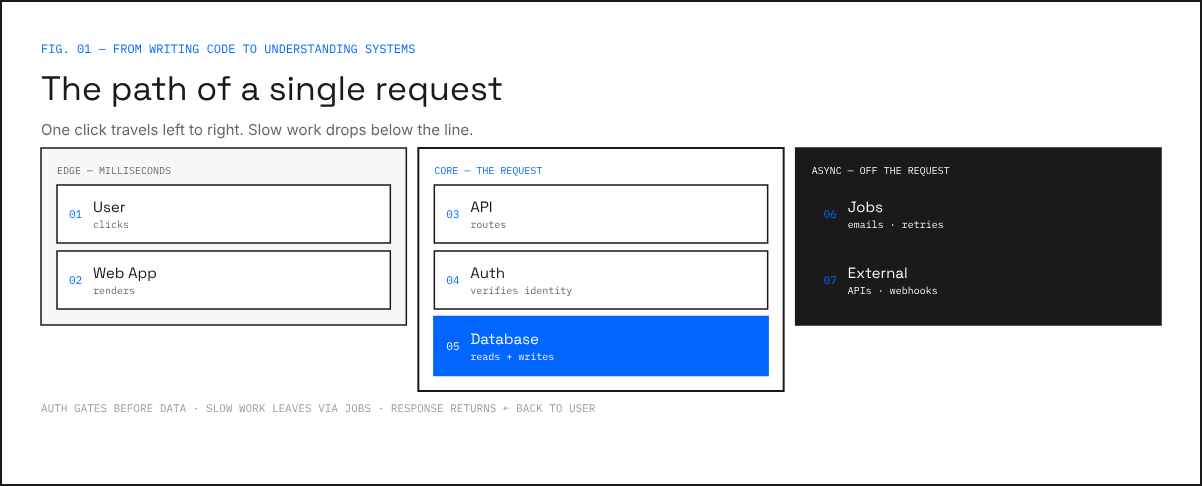
When building a real product, the hardest questions are rarely:
How do I write this function?
They are more often:
Where should this logic live?
What should happen when this service fails?
What data should be stored?
Who is allowed to perform this action?
How does authentication flow through the system?
What happens when two requests arrive at the same time?
How does the application behave when traffic increases?
What should be logged?
How do we know something is broken?
What happens when a third-party service is unavailable?
These are system questions.
You can ask AI to generate an implementation for almost any of them. But generating code is not the same thing as knowing whether the generated solution is actually a good one.
That responsibility still belongs to the engineer.
The bigger picture becomes more important
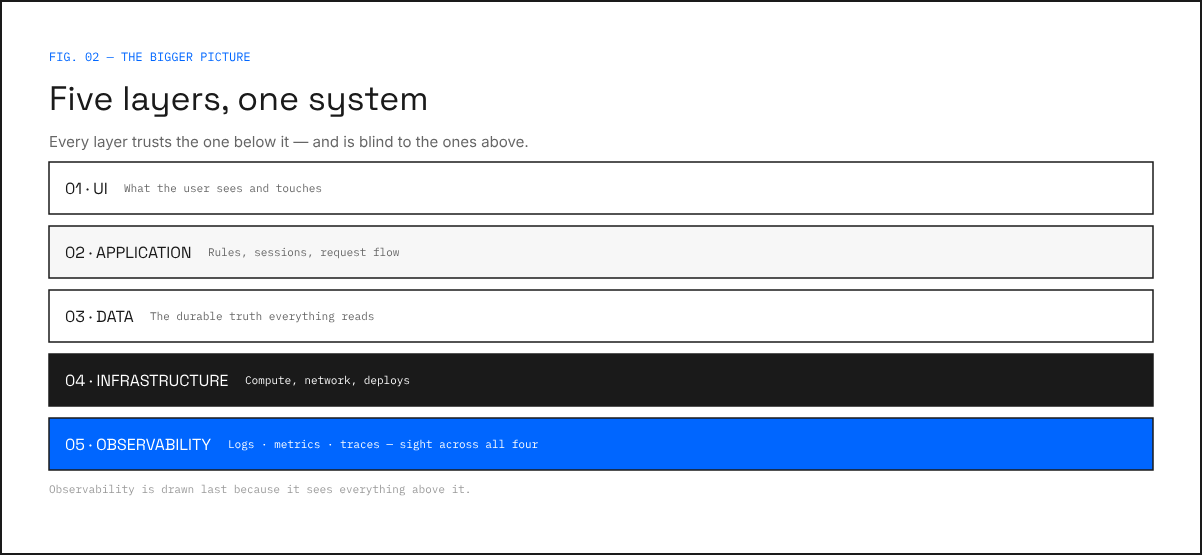
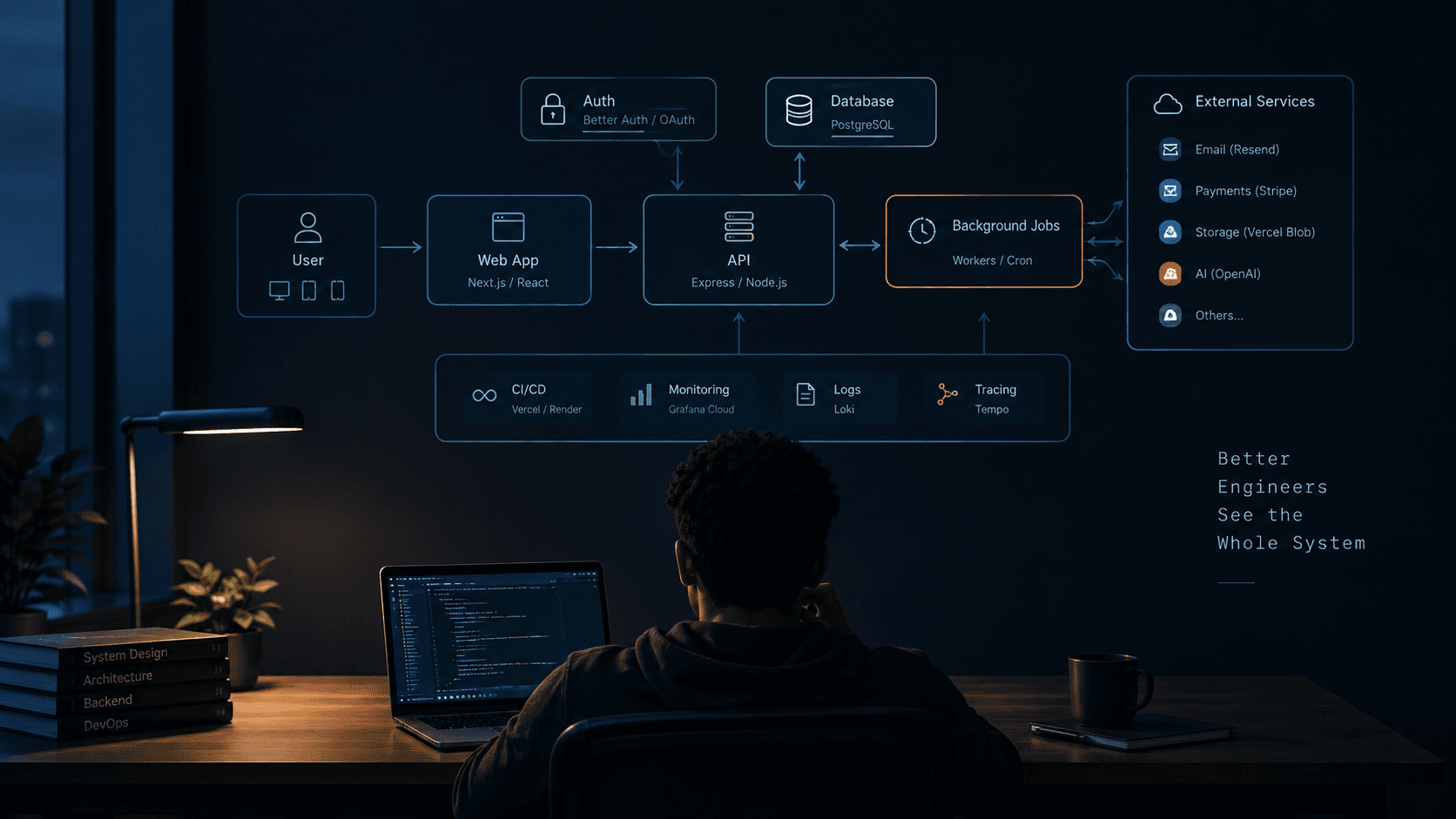
A modern application is not just a frontend and a backend.
It might contain a web application, an API, authentication, a database, background jobs, object storage, email, payments, caching, observability, queues, third-party APIs, CI/CD, and infrastructure.
Each individual technology can be learned relatively quickly.
Understanding how they fit together is much harder.
That is why I think system architecture and design are becoming increasingly important.
You need to be able to zoom out.
Instead of thinking only about a React component, think about the request that started before that component rendered and everything that happens after the user clicks a button.
Instead of thinking only about a database query, think about why that data exists, who owns it, how it changes, how it is accessed, and what happens when the query becomes expensive.
Instead of thinking only about an API endpoint, think about authentication, authorization, validation, idempotency, failures, retries, observability, and deployment.
The individual pieces change.
The underlying way of thinking does not.
Learning speed is becoming a technical skill
There is another shift happening.
The number of technologies a developer can reasonably encounter is growing faster than ever.
A framework you learn today may be replaced or significantly changed in a few years. A new database, deployment platform, AI tool, or architectural pattern can become relevant surprisingly quickly.
Trying to memorize everything is not a realistic strategy.
Instead, I want to become good at entering an unfamiliar technical environment and figuring it out.
Read the documentation.
Understand the mental model.
Build something small.
Break it.
Read the source when necessary.
Ask questions.
Compare alternatives.
Then use it in a real system.
That process is becoming one of the most valuable skills a developer can have.
The goal is not to know everything.
The goal is to be able to learn almost anything you need.
AI changes the value of specialization
I do not think specialization is dead.
Deep knowledge still matters, especially in areas where mistakes are expensive.
But AI is changing the economics of implementation.
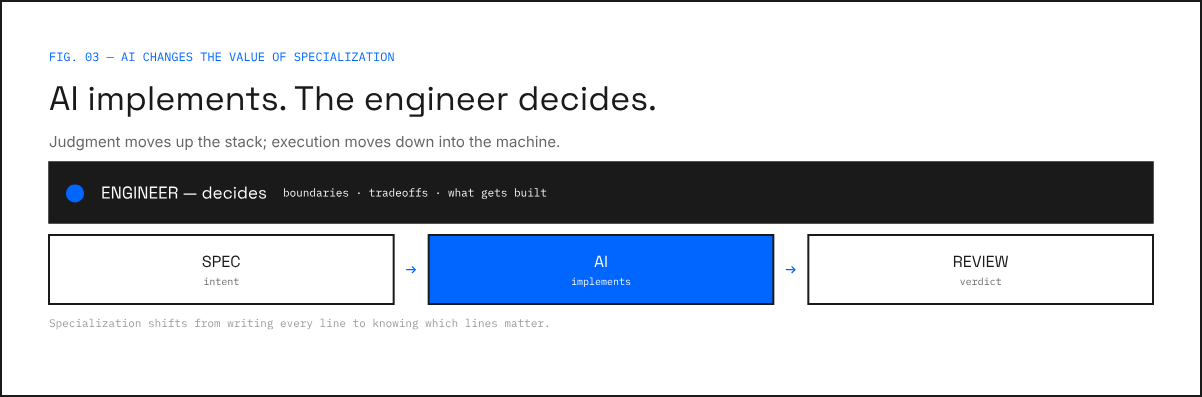
If an engineer can use AI to become productive in an unfamiliar framework within a few days, then knowing one framework extremely well is no longer the only advantage.
The advantage shifts toward knowing what needs to be built and why.
Imagine two developers using the same AI coding assistant.
One understands the architecture, the constraints, the tradeoffs, and the failure modes.
The other mainly knows how to ask the AI to produce code.
They have access to similar implementation power.
But they do not have the same engineering ability.
The first developer can direct the system.
The second is mostly reacting to what the system produces.
That distinction matters.
Build more kinds of software
This is also changing how I want to learn.
Instead of spending years trying to become extremely good at one narrow part of development, I want to build different kinds of systems.
A SaaS application.
A backend-heavy application.
Something with real-time functionality.
Something involving AI.
Something that requires background processing.
Something deployed and monitored in production.
Something that fails in interesting ways.
Each project forces me to learn a different part of the larger picture.
The point is not to collect technologies for the sake of a résumé.
It is to develop architectural intuition.
After enough projects, you start recognizing patterns.
You have seen authentication fail.
You have dealt with migrations.
You have encountered race conditions.
You have dealt with bad API boundaries.
You have watched logs become useless.
You have deployed something and discovered that development and production are very different environments.
Those experiences become more valuable than simply having a list of technologies you have used.
The engineer of the future
I do not think the future belongs to developers who know the most syntax.
I think it belongs increasingly to developers who can move between levels of abstraction.
Zoom into the code when necessary.
Zoom out to the architecture when necessary.
Understand the product.
Understand the infrastructure.
Understand the user.
Understand the tradeoffs.
Use AI to accelerate implementation, research, debugging, and experimentation.
Then make the final engineering decisions yourself.
That does not mean becoming an expert in everything.
It means becoming comfortable enough with the whole system to understand how the pieces interact.
What I am optimizing for
This is the direction I want to take my own career.
I still want to become very good at writing software.
But I do not want my identity as an engineer to depend on one framework, one language, or one narrow area of the stack.
I want to be able to look at an unfamiliar system and understand it.
I want to be able to learn a new technology quickly.
I want to understand why an architecture works, where it will break, and what I would change.
And most importantly, I want to build things.
Because the fastest way I know to understand a system is to actually build one.
AI can help me write the code much faster.
But understanding what to build, how the pieces should fit together, and why the system should work that way is still an engineering problem.
And I think that problem is becoming more important, not less.